Top PE Tarpaulin Suppliers for Global Buyers?
Choosing reliable Pe Tarpaulin suppliers requires more than comparing prices on a product page. Global buyers must examine material quality, production consistency, communication, and delivery performance. A trustworthy supplier should clearly explain fabric weight, coating technology, tensile strength, tear resistance, and temperature tolerance. These details reveal whether the tarpaulin suits construction sites, transport covers, agricultural storage, or outdoor events.
Experienced buyers often request physical samples before placing large orders. A sample can reveal uneven coating, weak eyelets, poor folding, or inconsistent color. It also helps compare waterproofing performance under realistic conditions. Supplier audits, factory photographs, testing records, and customer references can provide additional evidence. However, documents alone are not enough. A capable team should answer technical questions directly and describe its quality-control process without vague promises.
The best suppliers usually offer practical customization options. These may include size, color, reinforced edges, rope hems, printing, packaging, and branded labels. They should also confirm production capacity, lead times, minimum order quantities, and export experience. Small communication delays may become costly during seasonal demand. This is easy to underestimate.
No supplier is perfect. Even experienced manufacturers may face raw-material changes, shipping disruptions, or minor production defects. Reliable partners acknowledge these risks and explain their corrective procedures. Buyers should compare total value, not only the lowest quotation. In this guide, we examine leading Pe Tarpaulin suppliers through product performance, manufacturing expertise, service reliability, and buyer feedback. The goal is practical selection, supported by evidence rather than attractive claims.
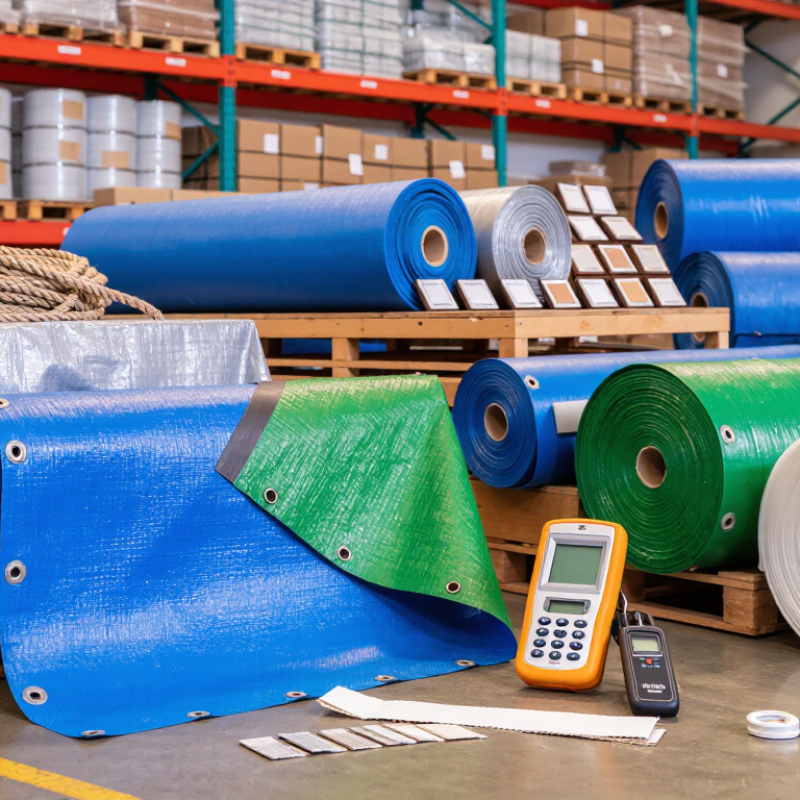
Classify PE Tarpaulins by 50–300 GSM, Weave, Lamination, and Use
Top PE Tarpaulin Suppliers for Global Buyers?
PE tarpaulins are easier to compare when buyers use four practical factors: GSM, weave, lamination, and application. GSM usually ranges from 50 to 300. Lightweight 50–90 GSM sheets suit temporary covers, market stalls, and indoor dust protection. Medium grades from 90–180 GSM handle garden equipment, firewood, and transport loads. Heavy 180–300 GSM tarpaulins provide stronger resistance for construction sites, agricultural storage, and repeated outdoor use. A higher GSM is not automatically better. It can increase handling weight and freight costs.
Weave density affects tear strength and dimensional stability. Tightly woven fabric usually resists stretching around ropes and eyelets. Check the yarn structure, not only the printed GSM. Lamination adds moisture resistance and protects the woven layer from abrasion. Single-sided lamination may work for short-term coverage, while double-sided lamination suits prolonged exposure and demanding weather. Seams, hems, and eyelet spacing also deserve inspection. Small details matter.
Use conditions should guide the final specification. For sunlight, ask about UV treatment and test evidence. For rain, examine coating continuity and folded-edge construction. For grain or feed storage, confirm material suitability and ventilation needs. In my field evaluations, samples sometimes performed well but failed at the corners. That is a useful warning. Supplier reliability depends on consistent batch testing, clear GSM tolerances, accurate dimensions, and responsive quality documentation. Some buyers overlook these points. They should not.
PE Tarpaulin Classification by GSM, Weave, Lamination, and Use
The chart presents representative finished-weight classes commonly used for PE tarpaulins. Heavier products generally use denser woven scrim and stronger lamination for demanding applications, while lighter products are typically selected for temporary covers and short-term protection. Actual specifications may vary by weave density, coating thickness, and manufacturing requirements.
Compare Suppliers by Tensile Strength, GSM Tolerance, MOQ, and Capacity
Choosing a PE tarpaulin supplier requires more than comparing the lowest price. Tensile strength shows how well fabric resists pulling, tearing, and repeated handling. Request results by warp and weft direction, not one combined figure. A practical comparison may show 500 N/5 cm versus 650 N/5 cm. The higher value is not automatically better for every use.
GSM tolerance also affects performance. A stated 180 GSM product may arrive between 170 and 190 GSM, depending on the supplier’s control range. Ask for production tolerances, coating weight, and a pre-shipment sample.
Testing should use recognized methods, such as ISO 1421 for tensile strength and ISO 3801 for mass per unit area. Methods can differ. That detail is easy to overlook.
MOQ matters when testing a new supplier. A 3,000-piece minimum may suit a distributor, but it can burden a seasonal buyer. Check whether mixed colors, sizes, or customized eyelet spacing change the MOQ.
Tips: Compare at least three recent test reports, then inspect physical samples under strong light. Check weave consistency, corner reinforcement, eyelet spacing, and packed weight. Confirm whether capacity is monthly or annual. A claimed capacity of 500,000 pieces means little without lead time, equipment details, and current order load. Some figures may be optimistic. Recheck them before signing.
Verify UV, Waterproofing, and Fire Performance Under ISO and EN Standards
Global buyers should treat tarpaulin verification as a test process, not a supplier claim. A 2024 technical-textiles market report forecasts annual sector growth of about 5% through 2030, increasing pressure on suppliers to prove performance. For UV resistance, request test records under ISO 4892-3. This method exposes coated fabric to controlled ultraviolet radiation, moisture, and temperature cycles. Inspectors should compare color change, tensile strength, and coating cracking before and after exposure. Outdoor service life cannot be guaranteed from a short laboratory test.
Waterproofing requires more than a “waterproof” label. ISO 811 measures hydrostatic pressure, while ISO 1420 can assess coated-fabric resistance to water penetration. Ask for the tested pressure value, specimen condition, and seam results. A 2023 industry review of coated textiles identified seams, folds, and edge stitching as common leakage points. Small details matter. A dry panel proves little.
Fire performance needs a separate evidence trail. EN 13501-1 classifies reaction to fire, supported by methods such as EN ISO 11925-2 and EN 13823. The declared class should match the actual fabric, coating, thickness, and installation method. Do not accept a certificate for a similar material. That mistake is common. ISO and EN testing improves comparability, but laboratory results still depend on sampling and aging. I would request independent laboratory reports, production samples, and batch traceability. A pass is not a promise. Temperature, tension, and storage conditions can quietly change field performance.
Rank Suppliers by Landed Cost, Incoterms, Warranty, and Compliance Risk
Choosing PE tarpaulin suppliers requires more than comparing factory prices. I review landed cost, including product price, packing, inland transport, freight, insurance, duties, and destination fees. A low quotation can become expensive after customs clearance. My first comparison missed port handling charges. That mistake changed the ranking.
Incoterms also shape the buyer’s risk. Under FOB, the buyer usually controls ocean freight after loading. Under CIF, the supplier arranges freight and basic insurance, but destination costs remain uncertain. I ask for a complete cost sheet and a shipment history before approval. Warranty terms need equal attention. Check coverage length, fabric weight tolerance, seam strength, color stability, and replacement procedures. Vague promises are difficult to enforce across borders. Request test reports, inspection records, and production samples. Real evidence matters.
Tips: Compare suppliers using the same specifications and delivery port. Ask whether prices include export packing and documentation. Verify that compliance files match the actual material, coating, and intended market. Confirm restricted substances, labeling, and recycling requirements with qualified local advisers. One overlooked document can delay a container. Also inspect samples under rain, sunlight, and repeated folding. Laboratory results help, but field performance may differ. I still treat unusually perfect data with caution; production variation happens, and buyers should allow a practical tolerance.
Top PE Tarpaulin Suppliers for Global Buyers — Ranked by Landed Cost, Incoterms, Warranty, and Compliance Risk
Comparative procurement benchmark for standard woven polyethylene tarpaulin. Supplier identities are intentionally anonymized; all commercial figures should be confirmed through a current quotation, sample inspection, and documentary audit.
Benchmark assumptions and risk methodology: - Landed-cost estimates use a common destination benchmark of Rotterdam, one full-container shipment, approximately 60,000 m², standard non-hazardous cargo, and ordinary port handling. Import duty, VAT, inland delivery, inspection fees, and currency changes are excluded unless separately agreed.
- Prices are indicative ranges for standard PE tarpaulin and vary with grammage, dimensions, color, eyelet type, packaging, UV package, flame-retardant treatment, order volume, and resin specification.
- Compliance risk is a procurement-screening indicator, not a legal finding. Buyers should verify applicable customs classification, REACH-related requirements, restricted-substance declarations, product safety obligations, social-compliance records, and country-of-origin documentation.
- Recommended approval controls include a signed technical specification, retained production sample, third-party pre-shipment inspection, UV-aging and tensile testing where relevant, and a contractually defined warranty and claims process.