

China Top 10 Gaming Mouse Manufacturers
Gaming hardware is judged in milliseconds, but a mouse is also shaped by comfort, durability, and price. For players, the difference can be tangible: a textured shell under the fingers, a cable that drags across the desk, or a click that feels too heavy. These details help explain why China’s gaming-mouse manufacturers deserve closer attention.
Newzoo’s Global Games Market Report 2024 estimated worldwide games revenue at $187.7 billion, with about 3.4 billion players. This figure describes the broader games market, not gaming-mouse sales. Still, it shows the scale of the audience that gaming peripherals may serve. Razer co-founder and CEO Min-Liang Tan’s well-known brand principle is, “For Gamers. By Gamers.” It captures a useful idea: products should be assessed against real play, not just feature lists.
This overview of China Top 10 Gaming Mouse Manufacturers considers product range, manufacturing capability, customization, and evidence of export experience. It also looks at practical features, including sensor specifications, switch options, weight, and software support. These criteria cannot tell the whole story. Public company information varies, and a polished product page is not proof of consistent quality. That is a limitation worth remembering. The phrase Mouse Gaming may sound broad, but buyer needs are not: a competitive player, an office user, and a private-label brand may seek very different designs. The companies ahead should therefore be read as a research shortlist, not a definitive ranking.
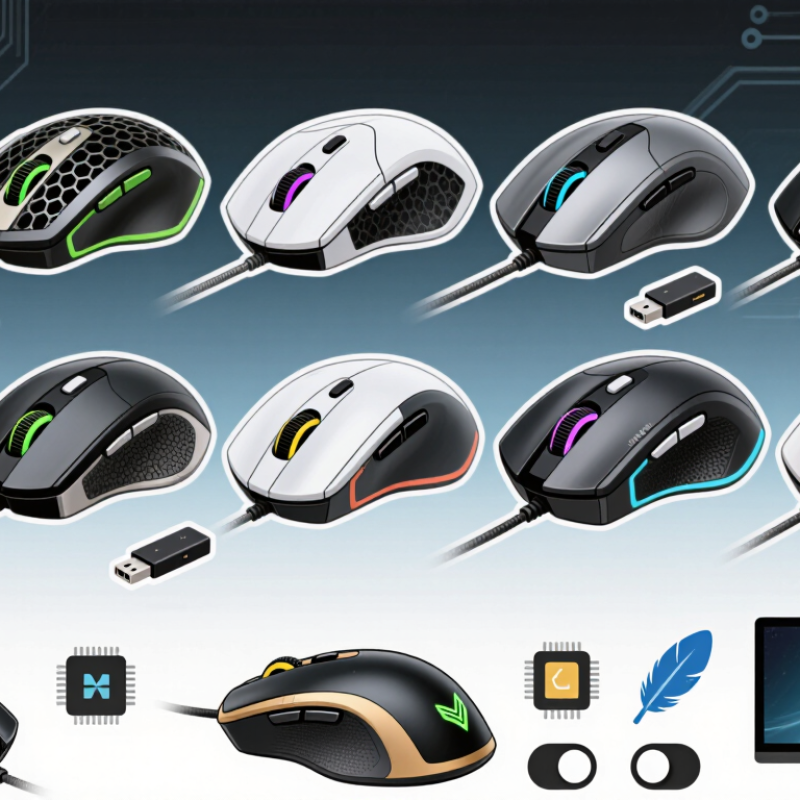
Overview of China’s Gaming Mouse Manufacturing Industry
China’s gaming mouse manufacturing industry combines component sourcing, product engineering, assembly, and export services. Many factories work with specialized suppliers for switches, sensors, cables, and molded shells. This network can shorten development cycles, though lead times still depend on component availability and order size. Some manufacturers focus on OEM or ODM projects; others handle tooling, firmware tuning, packaging, and quality checks in-house. Capabilities vary widely. A polished sample does not prove stable mass production.
Product development often balances weight, shape, click feel, wireless performance, and cost. Engineers may test shell flex, scroll-wheel consistency, and sensor tracking on different desk surfaces. Quality teams should also inspect battery performance, connection stability, and repeated button cycles. Buyers need clear specifications, sample approval records, and written inspection criteria before production. These steps sound basic, but rushed projects sometimes skip them. That can create avoidable surprises.
Tips: Ask for production samples, not only showroom units. Confirm test methods, defect limits, and packaging details in writing. Check whether the factory controls critical processes or relies on outside partners. A short factory visit can help, but it cannot replace ongoing inspection. Compare claims with measurable records. Simple, but useful.

Criteria for Selecting Leading Gaming Mouse Manufacturers
A capable gaming mouse manufacturer should show more than a polished sample. Ask how it controls sensor placement, switch installation, and shell tolerances across production runs. A mouse that feels solid in one hand-built unit may develop uneven clicks when thousands are assembled. Request inspection records and sample units from a normal production batch, not only showroom pieces.
Test the details players notice during long sessions. Check whether the scroll wheel moves cleanly, side buttons register consistently, and the cable or wireless connection stays stable during repeated movement. Ask for documented tracking, click-cycle, and surface-wear tests, including the methods and sample sizes used. Ask for proof. Clear answers are more useful than broad claims.
Manufacturing experience also matters. A supplier should explain its tooling, material choices, repair process, and ability to handle design changes without hiding trade-offs. For example, a lighter shell may flex more, while heavier switches can feel tiring after hours. Feel matters. I would not judge quality from specifications alone; test units on different surfaces and ask operators what failed in earlier runs. No factory is perfect, and a candid record of defects can be more credible than a flawless-looking presentation.
Profiles of China’s Top 10 Gaming Mouse Manufacturers
China’s gaming mouse sector includes manufacturers with distinct strengths, from rapid prototyping to high-volume production. These profiles focus on capabilities rather than brand names or an audited ranking. That distinction matters: factory scale alone does not prove consistent performance.
Some manufacturers specialize in lightweight shells and precise sensor integration. Others offer OEM and ODM services, adapting shape, switches, cable routing, and software for client requirements. A useful factory visit would include checking scroll-wheel feel, side-button wobble, and click consistency across several samples. Small differences can become obvious after hours of play.
Grand View Research estimated the global gaming peripherals market at USD 6.5 billion in 2023, with projected growth of 10.2% annually from 2024 to 2030. This wider category includes more than mice, but the forecast helps explain manufacturers’ investment in testing and customization. Strong profiles typically document sensor performance, switch life, and quality-control procedures. Ask for the test method, not just the headline number. A shortlist still has limits. Public information about private factories can be thin, and one sample may not represent a full production run.
Key Technologies and Product Capabilities
A gaming mouse is a small device with little room for engineering mistakes. Manufacturers must balance sensor accuracy, click response, weight, and durability. A high polling rate can reduce input delay, but it means little if tracking becomes unstable during quick, low-sensitivity movements. Teams should test across different surfaces, not just a clean laboratory pad. Details matter.
Optical sensors, switch design, and firmware shape the experience. Skilled engineering teams tune lift-off distance and motion filtering, then check whether settings remain consistent across repeated tests. Mechanical switches need clear actuation and reliable feedback. A crisp click feels useful; an overly stiff one can tire a player’s hand. Lightweight shells also require careful structural testing around button hinges and the scroll wheel.
Manufacturing capability shows in repeatability. A sample may perform well, yet production units can vary in button force, wheel steps, or shell fit. Incoming-part checks and final testing help catch those differences. Some quality checks still miss problems that appear after months of use. That is worth admitting. Ergonomic claims also need restraint: hand size and grip style change how a mouse feels. Clear specifications, realistic test conditions, and responsive support are stronger signals of expertise than dramatic performance promises.
| No. | Capability Area | Common Technologies and Options | Product Capability | What Buyers Can Verify |
|---|---|---|---|---|
| 1 | Optical sensor integration | Optical tracking sensors with adjustable CPI/DPI; available ranges depend on the selected sensor and firmware. | Configurable sensitivity steps, lift-off-distance settings, and surface tracking for different play styles. | Sensor part number, supported CPI steps, tracking specifications, and performance test results. |
| 2 | Polling-rate implementation | USB polling options commonly include 125 Hz, 500 Hz, and 1,000 Hz; higher-rate models may offer 2,000 Hz, 4,000 Hz, or 8,000 Hz. | Selectable report rates for balancing input responsiveness, system compatibility, and power consumption. | Supported rates in wired and wireless modes, host compatibility, and measured report-rate consistency. |
| 3 | Wireless connectivity | 2.4 GHz radio links with a USB receiver; some designs also support Bluetooth and wired USB operation. | Multi-mode connectivity for gaming, everyday use, and charging or wired operation, depending on the model. | Connection modes, receiver type, battery capacity, operating-time test conditions, and wireless performance data. |
| 4 | Weight and shell design | Injection-molded shell components and internal structural layouts; gaming mouse weights vary widely, with lightweight designs often below 60 g. | Symmetrical or ergonomic shapes, solid or perforated shells, and configurations designed for different grip styles. | Measured weight with and without cable or receiver, shell drawings, sample finish, and dimensional tolerances. |
| 5 | Main-button switches | Mechanical and optical switch designs are both used in gaming mice; actuation feel and rated life vary by component. | Options for different click feel, actuation behavior, and debounce or click-response settings where supported. | Switch manufacturer and model, component datasheet, rated cycle conditions, and click consistency testing. |
| 6 | Scroll-wheel assembly | Mechanical or optical encoder designs, with different wheel materials, detents, and support structures. | Tactile scrolling and middle-click input; wheel feel and step behavior can be tuned through component selection. | Encoder specification, scroll-step consistency, middle-click performance, and cycle-test results. |
| 7 | Firmware and controls | Firmware can support button remapping, CPI profiles, polling-rate selection, and lighting controls, depending on the product design. | Onboard profiles and software-based configuration are available on some models; macro and memory features are model-specific. | Software compatibility, onboard-memory behavior, profile switching, firmware update process, and feature list. |
| 8 | Feet, cable, and surface contact | Low-friction mouse feet, replaceable skates on selected models, flexible cable constructions, and wireless alternatives. | Options to adjust glide feel, cable drag, and maintenance needs across different desk and mouse-pad surfaces. | Foot material and thickness, cable construction, replacement-part availability, and glide testing on defined surfaces. |
| 9 | Manufacturing and customization | Typical production processes include plastic injection molding, electronic assembly, firmware loading, final assembly, and packaging. | OEM/ODM projects may involve housing, color, surface finish, button layout, packaging, and firmware customization. | Production samples, tooling ownership terms, approved materials, customization scope, and documented production controls. |
| 10 | Quality and reliability testing | Product validation can include button and wheel cycling, wireless connection checks, charging tests, and inspection of fit and finish. | A defined test plan helps assess consistency between samples and production units; test conditions differ by manufacturer and model. | Written test procedures, sample reports, acceptance criteria, traceability, and applicable regulatory documentation. |
| Note: This table is an industry capability overview, not a verified ranking or a supplier-specific specification sheet. Options and performance vary by model, component selection, firmware, and test conditions; verify all claims against current product documentation and samples. | ||||
How to Evaluate and Source from Chinese Manufacturers
Evaluating Chinese gaming mouse manufacturers starts with the product, not the catalogue. Ask for the sensor model, switch specifications, encoder type, cable length, and measured weight. Request a sample with the exact shell, firmware, and surface finish planned for production. A polished sample can hide differences in mass production. Check several units, not just one.
Test tracking on different mouse pads, including a textured cloth surface. Record lift-off behavior, click consistency, and scroll-wheel noise. Ask how the factory controls button travel and shell gaps. Useful evidence includes inspection records, assembly photos, and clear answers about defect handling. Vague claims are not proof. A video call from the production floor can help, though it cannot replace an independent inspection.
Before placing an order, confirm tooling ownership, packaging details, lead time, payment milestones, and the process for approving design changes. Put tolerances and acceptance criteria in writing; “good quality” means little without measurable limits. Compare quotes against the same specification, since a lower price may omit testing or spare parts. I once focused too much on unit cost and overlooked packaging damage during transit. That was avoidable. Still, even careful checks cannot remove every risk, so begin with a manageable pilot order and review the results before scaling.


