

What Is the Best COB LED Strip Light in 2026?

Choosing the best COB LED strip light in 2026 means looking beyond a smooth, dot-free glow. A strip may appear flawless in a product photo, yet run hot inside a shallow aluminum channel. The difference shows up in brightness consistency, color accuracy, adhesive performance, and long-term reliability.

The U.S. Department of Energy says LED lighting can use at least 75% less energy and last up to 25 times longer than incandescent lighting. These are broad LED comparisons, not guarantees for every COB strip. Its 2022 Solid-State Lighting R&D Opportunities report also identifies efficiency, color quality, reliability, and cost as important areas for continued development. Those measures help frame a fair comparison.

Looks simple. Not quite. For this guide, we’ll consider light output per meter, color temperature, color rendering, cutting intervals, dimmer compatibility, and heat management. We’ll also look at the details buyers can miss: power-supply sizing, waterproofing claims, and whether the stated brightness applies to a full roll or one meter. A higher LED count alone does not prove better performance. Nor does a low price reveal how a strip behaves after hours of use. The right choice depends on the installation, the desired light, and credible specifications. Where product claims lack clear test conditions, treat them cautiously; even a careful comparison has limits.
What Is the Best COB LED Strip Light in 2026?

How COB LED Strip Lights Produce Continuous, Dot-Free Illumination

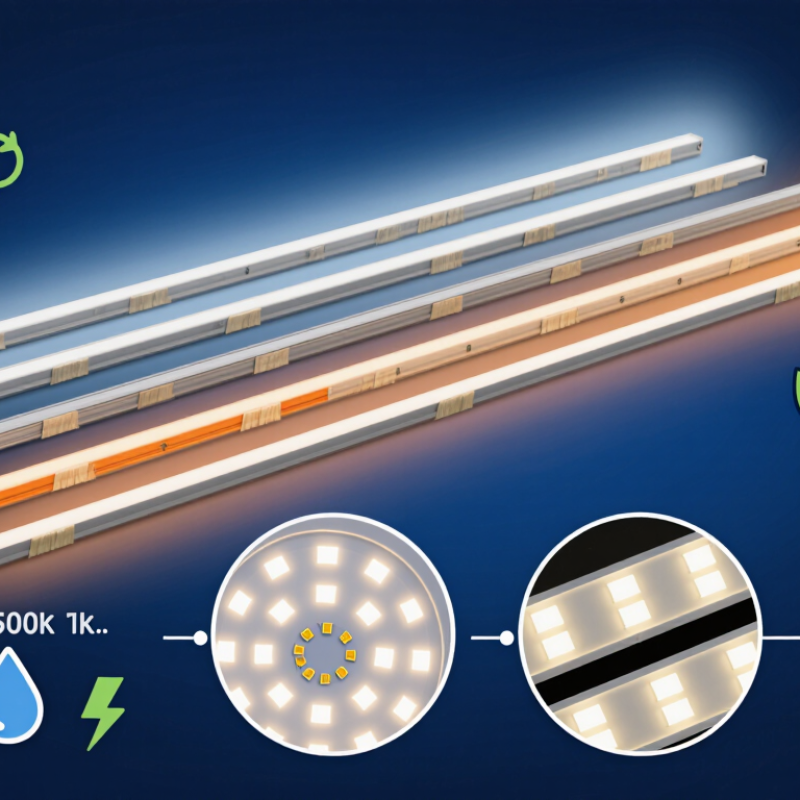
COB LED strips place many small LED chips close together on a flexible circuit board, then cover them with a continuous phosphor layer. The light blends before it leaves the strip, so individual points are much harder to see than on widely spaced LEDs. No dotted trail. Under a kitchen cabinet, this can make a countertop appear evenly lit rather than striped. The effect still depends on viewing distance, surface finish, and the strip’s quality.

A diffuser can soften the light further, though it may reduce brightness. For a clean installation, press the strip onto a dry, smooth surface; an aluminum channel can help manage heat and keep the line straight. Heat matters. Long runs may also show brightness changes if voltage drops along the strip, so check the manufacturer’s guidance on run length and power feed points. Match the power supply to the strip’s voltage and total wattage, with some capacity to spare. I would not judge a COB strip by appearance alone: compare brightness, color consistency, and heat behavior in the actual space. Even good strips can look different against glossy tile or pale paint.

Which Specifications Matter When Comparing COB LED Strips

Choosing the best COB LED strip in 2026 means comparing more than advertised brightness. Check lumens per meter, not just total lumens, and consider how far the strip will sit from the surface. Color temperature shapes the mood: 2700K feels warm, while 4000K appears more neutral. For kitchens or display work, a high CRI can help colors look more natural. Still, CRI alone does not tell the whole story.

Look at the strip’s voltage, wattage per meter, and recommended power supply. A longer run may lose brightness near its far end, especially with lower-voltage strips. That matters. Check the cut intervals and connector width before planning corners or cabinet channels; a few millimeters can complicate installation. Match the IP rating to the setting, but remember that the rating depends on proper sealing after cutting. A spec sheet may not explain that clearly.

Also verify dimmer compatibility, control method, and whether the strip needs an aluminum channel to manage heat. Compare light output at the color temperature you will actually use, since figures can vary by model and test conditions. If possible, test a short section on the intended surface. I would not assume the brightest option is best; glare, uneven diffusion, or awkward wiring can outweigh a strong lumen figure. Small details count.

What Is the Best COB LED Strip Light in 2026? — Which Specifications Matter When Comparing COB LED Strips

Use case Typical COB strip specification Light output Color quality Protection and installation What to check before buying
Best all-around indoor choice 24 V DC; about 320–480 LEDs/m; approximately 8–12 W/m; single-color white Typically about 600–1,000 lm/m CRI ≥90; commonly available in 2700–6500 K IP20 for dry indoor locations; cut points and adhesive backing vary by model A balanced option for shelves, coves, and general accent lighting. Confirm the actual lumen output, cut interval, and compatible dimmer.
High-output task or display lighting 24 V DC; about 480–528 LEDs/m; approximately 12–16 W/m; single-color white Often about 900–1,400 lm/m, depending on color temperature and construction CRI ≥90 is a useful target for merchandise and work surfaces Usually best installed in an aluminum channel to help manage heat Check watts per meter, thermal limits, power-supply capacity, and whether the brighter output will cause glare in the intended position.
High color fidelity for interiors 24 V DC; about 320–480 LEDs/m; approximately 8–12 W/m; warm or neutral white Commonly about 500–900 lm/m; high-CRI versions may produce less light at the same power Look for CRI ≥95; R9 data is useful when saturated reds matter IP20 is typical for dry indoor use; use a suitable channel where the strip may be touched or exposed Choose a stated CRI and color temperature rather than relying on “high quality” wording alone. Check color consistency across reels.
Wet or dusty locations Typically 24 V DC; about 320–480 LEDs/m; approximately 8–12 W/m; sealed white COB strip Often about 500–900 lm/m; sealing can affect output and heat dissipation CRI ≥90 is commonly available; verify the required color temperature IP65 generally indicates protection against water jets; IP67 indicates temporary immersion under specified test conditions. Connectors and cut ends need appropriate sealing. Match the IP rating to the exposure. Confirm the rating applies to the complete installation, not just the uncut strip.
Short runs or fine cut spacing 12 V DC; about 320–480 LEDs/m; approximately 8–10 W/m; single-color white Typically about 500–850 lm/m CRI ≥90 is a practical baseline; confirm the available CCT Cut intervals are model-specific and are often shorter on 12 V strips; use only the marked cut points 12 V can be convenient for short sections, but voltage drop may be more noticeable on long runs. Check the manufacturer’s maximum run guidance.
Adjustable warm-to-cool white Usually 24 V DC; dual-channel tunable-white COB; approximately 10–16 W/m Output varies with the selected white tone and channel balance Often adjustable across roughly 2700–6500 K; verify CRI across the full range Requires a compatible two-channel controller and power supply Check the controller type, available color-temperature range, and whether the stated power is per meter at full output.
Color-changing effects Typically 24 V DC; RGB or RGBW COB; power and LED density vary by model Brightness depends on the selected color and how many channels are on CRI is generally not a useful comparison for saturated RGB output; RGBW adds a dedicated white channel Requires a matching multi-channel controller; check whether the strip is addressable or uses whole-strip color control For usable white as well as color, compare RGBW models and inspect the white-channel CCT and CRI separately.

Figures are typical comparison ranges, not guarantees; COB strip specifications vary by construction, color temperature, and supplier. Before selecting a strip, verify its datasheet for voltage, watts per meter, lumens per meter, CRI, cut interval, maximum continuous run, IP rating, and dimmer compatibility. Size the power supply for the total connected load and follow the manufacturer’s installation guidance.

How to Match a COB Strip to Your Space and Lighting Goals

The best COB LED strip depends on the room, not just its brightness rating. For a reading nook or kitchen counter, choose a strip with strong, even output and a high color-rendering index, ideally CRI 90 or above. Warm white around 2700–3000 K suits bedrooms and relaxed living areas; 3500–4000 K often feels clearer in work zones. Check lumens per metre, too. Watts alone do not tell you how bright the surface will look.

Measure the run and inspect the installation before buying. A long strip may show dimmer output at its far end, so 24-volt models and suitable power-feed points can help. Use a diffuser under cabinets to soften reflections on glossy counters. For exposed areas near splashes, check the stated IP rating and installation guidance; a sealed strip still needs room to release heat. Small details matter.

Energy performance is useful, but it is not the whole decision. The U.S. Department of Energy reports that LEDs use at least 75% less energy and can last up to 25 times longer than incandescent lighting. Those figures describe LEDs broadly, not a guarantee for every COB strip. Compare the product’s tested efficacy, rated life, warranty, and dimmer compatibility. I would still mock up a short section first; wall color and diffuser choice can change the result more than expected.

How Top COB LED Strip Options Differ in 2026

What Is the Best COB LED Strip Light in 2026?

How Top COB LED Strip Options Differ in 2026

In 2026, the best COB LED strip depends less on headline brightness than on where it will be installed. COB layouts place many chips close together, creating a smoother-looking line than widely spaced LEDs. Still, output, efficiency, and color quality vary.

A kitchen shelf needs useful light. Check lumens per meter, CRI, and color temperature. Warm white softens wood; neutral white reveals work surfaces. Small detail, big difference.

Top options also differ in strip width, cut intervals, voltage, dimming support, and moisture protection. A narrow channel may not fit a wide strip, even when its light looks ideal. Long runs can show brightness drop near the far end, so check the recommended maximum run and power-feed method.

There is no flawless spec sheet. Higher CRI may matter more beside a mirror, while outdoor-rated coatings can add bulk. That trade-off is easy to miss.

Tips: Measure the channel before ordering, confirm the driver matches the strip’s voltage and wattage, and test a short sample at night. If the color looks wrong, reconsider.

How to Check Power Compatibility, Installation Needs, and Durability

What Is the Best COB LED Strip Light in 2026?

A suitable COB strip starts with a power check, not a brightness claim. Match the strip’s rated voltage to its power supply, then calculate total load: a 5-meter strip drawing 10 watts per meter needs 50 watts. A 60-watt supply leaves practical headroom, but check the strip maker’s specifications and local installation conditions. Long runs can show voltage drop, causing dimmer light near the far end. Feeding power at both ends may help, though the right method depends on the strip and wiring layout. Small details matter. The U.S. Department of Energy’s Energy Saver guidance reports that LEDs use at least 75% less energy than incandescent lighting; that broad comparison does not guarantee a specific strip’s efficiency.

Installation affects reliability, too. Clean the mounting surface, avoid tight bends, and use an aluminum channel when the strip’s instructions call for added heat management. Heat trapped behind cabinetry can shorten component life. For damp locations, check the stated IP rating and installation limits rather than assuming a coating makes every setup waterproof. The DOE report LED Luminaire Lifetime: Recommendations for Testing and Reporting explains why lifetime estimates rely on lumen-maintenance testing and projections. So compare test conditions and warranty terms, not just a large hour figure. Even careful buyers can miss this: a strip’s published lifespan may not reflect an enclosed, hot installation.

What Is the Best COB LED Strip Light in 2026?

Check power compatibility, installation needs, and durability before choosing a strip.

Example power budget: This chart uses a 10 W/m strip and a power supply sized with 20% capacity above the calculated load. Actual strip power varies, so use the wattage on the product datasheet.

Compatibility: Match the power supply’s output voltage to the strip’s rated voltage. For a 5 m, 10 W/m example, the load is 50 W—about 4.17 A at 12 V or 2.08 A at 24 V. Installation: Check cut-mark spacing, connector width, polarity, and whether longer runs need power injection. Durability: Choose an IP rating suited to the location; exposed indoor areas and wet or dusty locations have different protection needs. Follow the manufacturer’s installation guidance.

REQUEST FOR PORPOSAL

Bring the essence of Current to your space! Whether you envision a cozy coffee kiosk, a stylish window café, a dynamic coffee bar, or a multi-station coffee drive-through, the possibilities are endless.  Please fill out the form below to submit your proposal request. Our team will review your information and get back to you shortly.